




Road to Music Therapy: Three Journeys, One Calling
April 27, 2026
Not every music therapist sets out to become one. For many, the profession finds them – a path that often feels less like a career choice and more like a calling.
Because of this, no two journeys look the same. Each therapist carries their own story into the work, shaped by the music they’ve loved, the challenges they’ve faced, the aspirations they’ve taken on, and the people who guided them along the way.
No matter how someone finds themselves involved in music therapy, it all converges towards one shared purpose: using music as a tool for healing.
The road to music therapy looks different for everyone. For these three therapists, it began in three very different places.
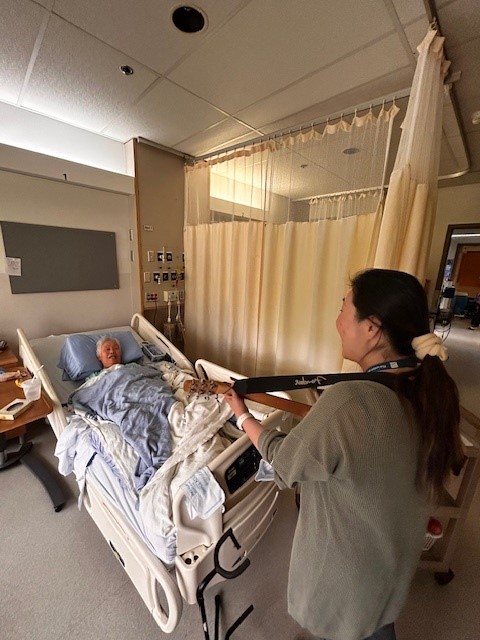
Music Therapist Eva Wong and Music Therapy Participant at Mount St. Joseph’s Hospital
At Mount St. Joseph’s Hospital in Vancouver, music therapist Eva Wong works with seniors in the hospital’s long-term care unit. Like herself, many of them are Chinese, speaking Cantonese or Mandarin as their first language, a cultural thread that ties together the music therapy program at the hospital.
But her journey there began years earlier – not as a therapist, but as a student.
“It started in grade 11 when I was going through career prep. We go through a lot of personality tests, seeing what we’re good at and what our interests are,” she said. “Music was the first thing that came up.”
Her school paired her with a music therapist at Mount St. Joseph’s, where she began volunteering. After gaining some experience, she decided to take the Music Therapy program at Capilano University, eventually completing an internship with the same hospital and music therapist she volunteered with.
When that music therapist decided to retire, she reached out to Eva for help.
“I volunteered for a few years, and when she retired eight or nine years ago, she asked if I would come in and carry the baton,” she said.
This full-circle moment wasn’t just a career step for Eva, it was a chance to give back in all the ways she knew how. Because at Mount St. Joseph’s, cultural understanding isn’t just an asset – it’s essential. “A lot of our residents are Chinese speaking, so she was really specific in finding someone who can speak the language and understand the culture to take over.”
“Culture plays a really big part in how we approach the individuals for music.” – Eva Wong, Music Therapist
This hasn’t just been a benefit to Eva’s patients, but is what feels most comfortable for her too.
“When I first started my music therapy journey as an intern, I ran groups in Cantonese, Mandarin, and then in English,” she said. “My preceptor actually said I was much more natural in my mother tongue than in English.”
Now, Eva leads sessions in the same halls she once trained in – and is mentoring the next generation of music therapy interns stepping into the field.
What began as a high school placement has become a career rooted in continuity – of language, of culture, and of care.
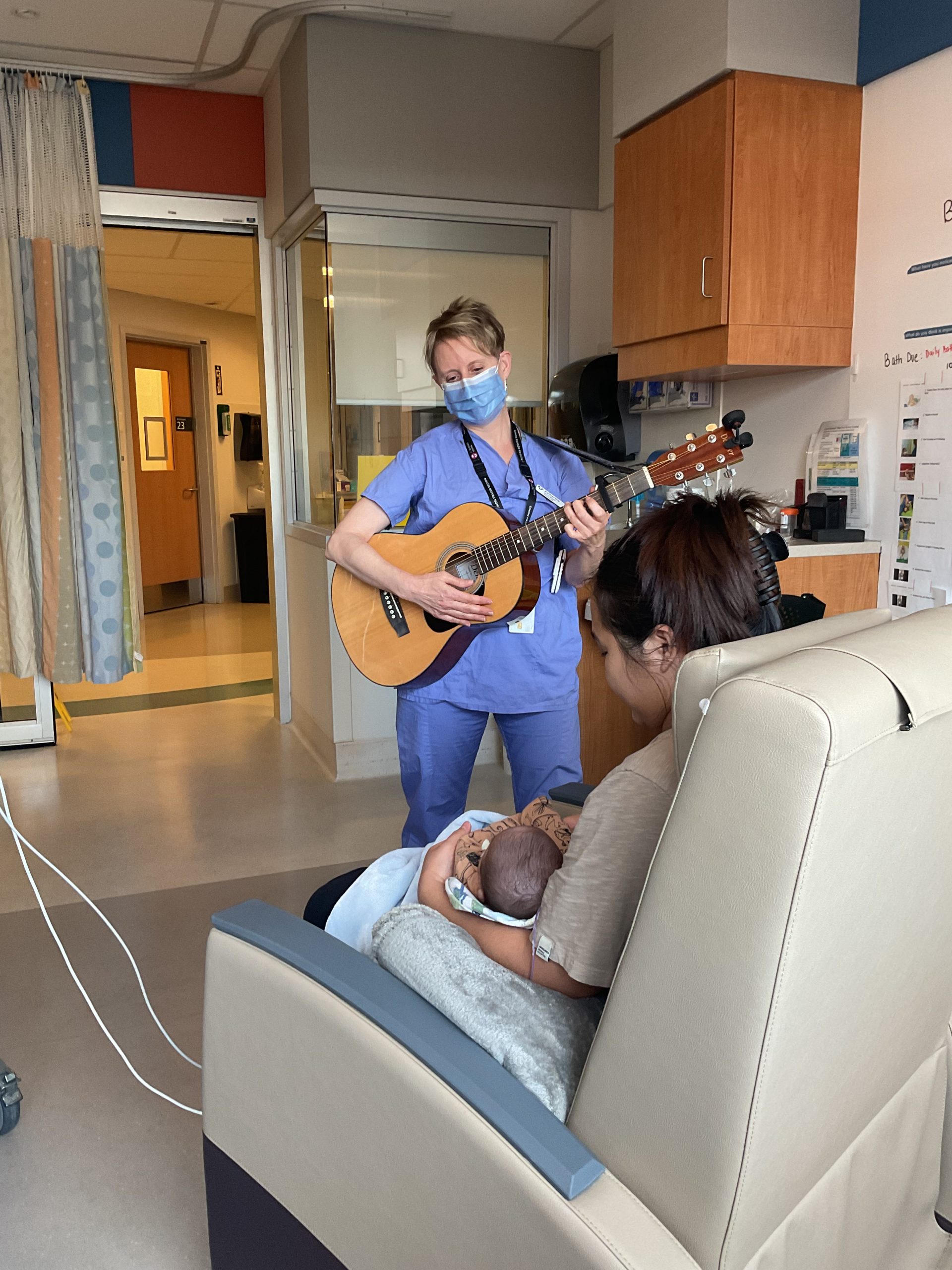
Music Therapist Katherine Deane and Music Therapy Participants at Surrey Memorial Hospital Neonatal Intensive Care Unit (NICU)
While Eva’s path to music therapy began in high school, not every journey into the profession starts so early – or so clearly.
For Katherine Deane, music therapist at Surrey Memorial Hospital’s NICU (Neonatal Intensive Care Unit), it was something she found much later in life, only after another dream had run its course.
Like many music therapists, Katherine didn’t grow up planning to become one.
“Music therapy was something that definitely found me.” – Katherine Deane, Music Therapist
She began her career in the performing arts, where she was certain a professional dance career would flourish.
“I started dancing when I was three years old,” she said. “Growing up as a child I knew I was going to be a ballet dancer.”
Out of high school she became a ballerina, dancing with the Alberta Ballet and some of the other prominent dance companies in the country.
But a knee injury cut her dance career short. “My career only lasted until I was about 21. It was only three years but it was so worth it and I’m so glad I got that far.”
Instead of taking the loss and leaving the arts behind, Katherine decided to pivot.
She learned to sing – something she says didn’t come naturally at first – and eventually auditioned for The Phantom of the Opera.
“I got in and did the Toronto production and the international touring production of Phantom. That got me into theatre,” Eva explained.
She continued performing for years before feeling ready for another shift. “I was ready to leave theatre in my 30’s.”
“I really didn’t want to lose everything I had gained in my 30 years and dump it for something else, so I looked into expressive arts therapies,” she said. “Through that, I found the music therapy program at Capilano.”
By then, she’s already spent decades immersed in music. But the turning point came during a university course.
“I was doing my psychology of infancy course at UBC, and for my midterm, I did a paper on music therapy in the NICU,” said Eva. “That’s what hooked me to the job I’m in.”
Katherine currently works in the NICU helping families bond with their babies through music and sound.
What began as performance eventually became purpose – Katherine now uses her musical talents not to generate applause, but to foster connection and development for newborn babies.
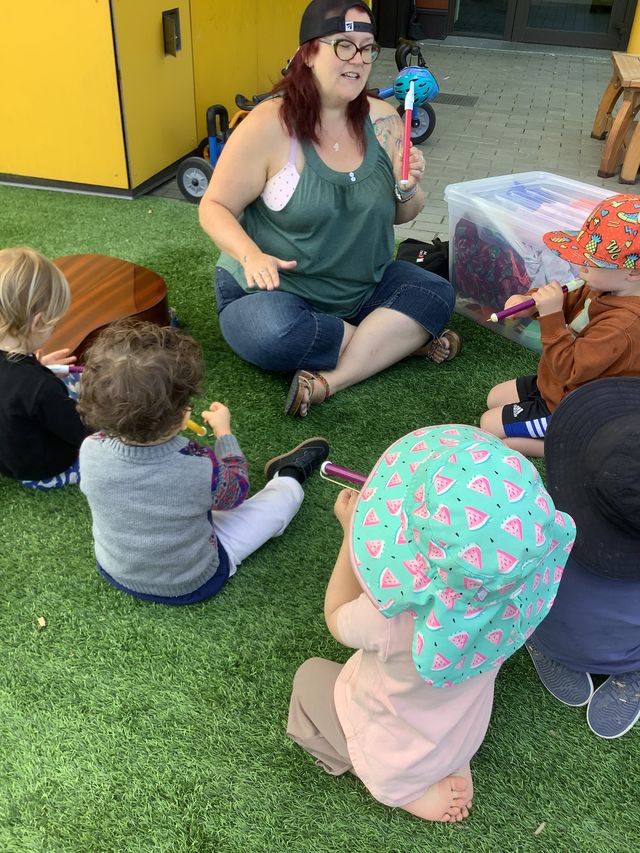
Music Therapist Alexina Davis and Music Therapy Participants at YMCA’s Robert Lee Childcare Centre
While Katherine’s path to music therapy unfolded through multiple reinventions, for others, the profession grew out of deeply personal experiences.
Alexina Davis is a music therapist at the YMCA’s Robert Lee Childcare Centre in Vancouver’s downtown east side, helping young children build emotional regulation, impulse control, and social skills through music.
For her, the path to music therapy began with a different ambition.
“I wanted to be a psychiatrist when I was younger,” said Alexina. “In high school, I applied to go into psych at SFU but didn’t get in.”
Music, however, had always been in her life.
“I was always into music, I can’t remember a time when I wasn’t singing,” she said. “My parents always joke about how they could tell I was sleeping because I stopped singing – I would sing myself to sleep.”
In high school, she played the guitar and saxophone, and was always involved in choir. But it wasn’t until she faced her own mental health struggles that music became something deeper.
“When I was a teenager, I went through a really, really rough patch,” she said. “I was actually using songwriting as my own process. I started with writing lyrics, then I learned how to play guitar, and then I started putting my poems to music.”
This form of self-expression resonated deeply with Alexina, especially in a time where she felt alone. “I didn’t connect with the singer-songwriters of the time anymore. I started to realize that I was singing songs about what others experienced and I didn’t have anything that really talked about what I was experiencing, so I started writing my own music.”
When she didn’t get into psychology, she pursued music instead – going to two music schools and earning a couple of degrees. But at 25, she found herself questioning what came next.
“I literally googled, ‘what can you do with a music degree that isn’t teaching?’ and music therapy popped up,” Alexina said.
She began volunteering before applying to the music therapy program at Capilano University – and that’s when everything clicked.
“I remember my first day at a senior center choir, I was standing in the back of the room bawling because I was just overwhelmed,” she recalled.
That moment confirmed what she had already felt in her own life – that music can reach places words sometimes can’t.
“Since then, I’ve felt so honoured to be able to hold these stories in my heart and be a part of various people’s lives,” she said. “I always knew that I wanted to do something in mental health, and it just made sense that music therapy was the piece for me.”
Alexina later completed a master’s in counselling, bringing together two of her early passions – music and psychology – into one practice.
—
There is no single road to music therapy. Some arrive through mentorship. Others through reinvention. Some discover it while healing themselves.
Though their journeys look different, each of these music therapists found a way to turn their passion for music into meaningful service and care.
But behind every music therapist is training that turns passion into practice.
In British Columbia, many of those journeys take shape at Capilano University, where hundreds of aspiring music therapists learn to transform lived experience and musical skill into evidence-based care. Through hands-on practicums and classroom learning, students learn to use music as a transformative change agent in a variety of settings, ranging from children with autism, to adults with mental health challenges, to seniors with dementia. Led by a strong team of career music therapists, the program continues to shape the future of music therapy across the province.
Blog Article Written by: Orchid Solang, BCIT Journalism Intern