



Inside a Music Therapy Session
April 15, 2026
At first glance, music therapy can look simple – a song sung at a bedside, a drum circle in a recreation room, or a lullaby in a hospital nursery.
But behind every note is intention.
Music therapy isn’t just entertainment; it’s assessment, collaboration, and carefully structured intervention. Before a single note is played, a music therapist asks questions: what are your goals? What are you struggling with? What brings you comfort or joy?
No two music therapy sessions look exactly the same, and that’s because no two people do. Music therapy is deeply individualized – shaped by age, ability, culture, and personal history. It fills the gaps that traditional healthcare sometimes cannot, working not only on symptoms, but on connections, identity, emotional regulation, and rehabilitation.
“It’s a collaboration between a therapist and a client – we meet in the middle.” – Edwina Lin, Music Therapist
And while the effort to meet halfway is constant, the way it unfolds can look vastly different from one setting to the next.
Music Therapy for Babies in the NICU
Inside the Neonatal Intensive Care Unit at Surrey Memorial Hospital, music therapist Katherine Deane works with some of the smallest patients – and their families – in what tends to be a quite stressful environment.
Katherine begins meeting families when infants reach at least 32 weeks gestation, when hearing is already well developed.
- Gestation: The period of time between conception and birth. In this case, babies born before 37 weeks are considered premature and require specialized care in the NICU.
“Hearing starts to form around 18 weeks gestation, and by 25 to 26 weeks, they can hear quite a bit,” she explains. “Even if they’re born at 32 weeks, they’ve had weeks of hearing their mother talk inside of the womb.”
Because sound is one of the earliest senses to develop, music becomes a natural entry point for connection.
“Infants don’t speak any languages, their brains are really wired for music.” – Katherine Deane, Music Therapist
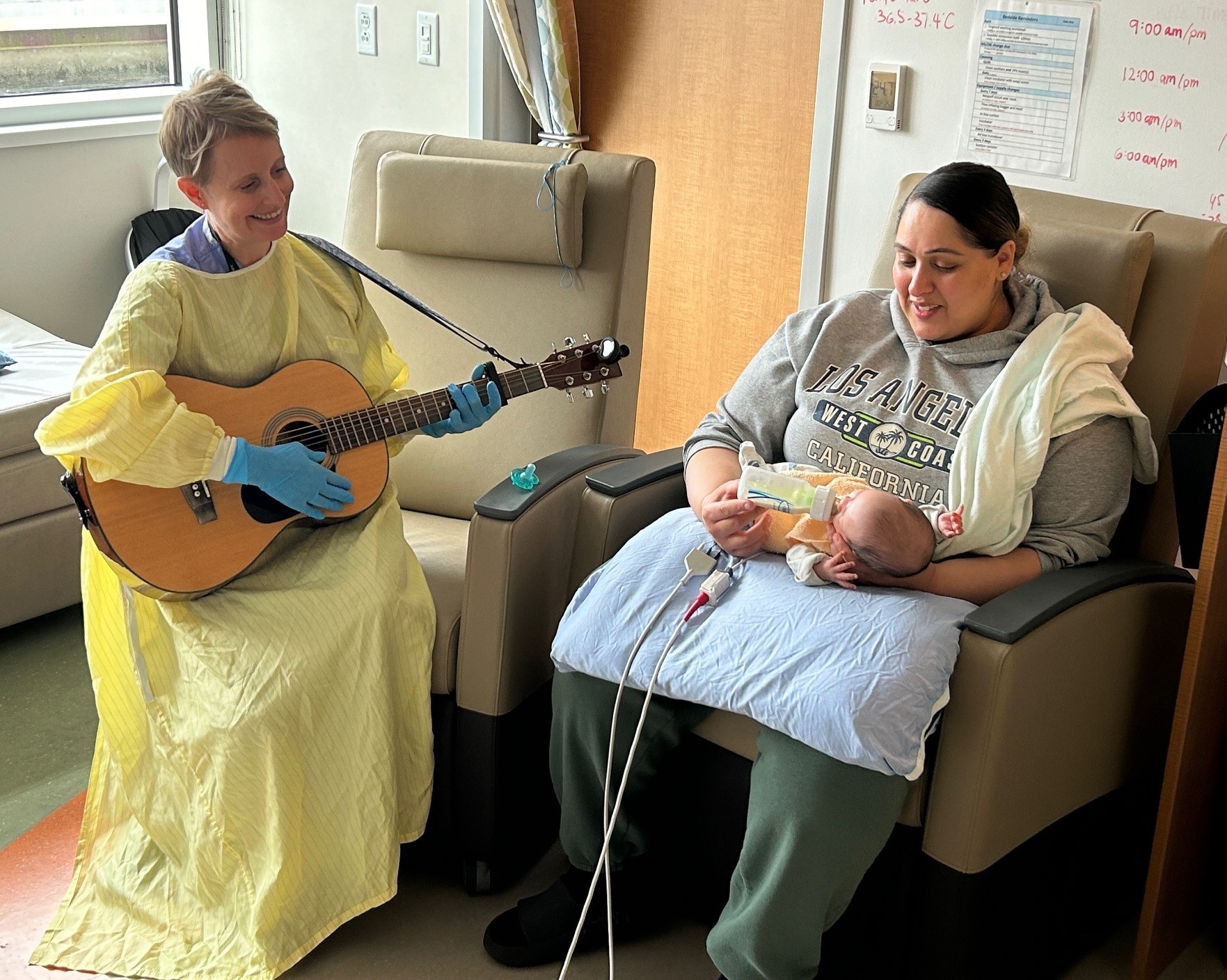
Music Therapy Participants and Katherine Deane, Music Therapist, SMH NICU
Katherine first educates parents on the power of their own voice. “I like to remind parents that their singing voice is much more calming and soothing. Speech can be very disorganized and not as easy for the baby to interpret emotionally.”
From there, she uses simple, live music – often just her voice and minimal instrumentation. “I’m just toning, maybe one or two tones, or an ascending scale. I might add a melody or lyrics, or add guitar underneath.”
And as she sings, she carefully monitors the baby’s responses.
“The nice thing about live music is you can layer and work with the reactions of the baby. I’m constantly looking for reactions,” she says. “A good reaction is basically no reaction. They either slowly fall asleep or they’re just calm and attentive, then I know they’re integrating well and their vitals are good.”
For babies who remain in hospital longer than 2 or 3 months, she incorporates purposeful touch – pairing predictable, gentle contact with music to promote regulation and bonding.
- Purposeful touch: The intentional, rhythmic, and nurturing physical contact (such as stroking, patting, or gentle movement) used by therapists or caregivers to stimulate neurological development, promote bonding, and regulate an infant’s stress responses in harmony with music.
Music Therapy for Children in Daycare
In Vancouver’s Downtown Eastside, music therapist Alexina Davis leads structured yet playful sessions at the Robert Lee YMCA – helping young children build emotional regulation, impulse control, and social skills through music.
“It might look like a circus if you walk in, but there’s actually structure and purpose behind every activity.” – Alexina Davis, Music Therapist
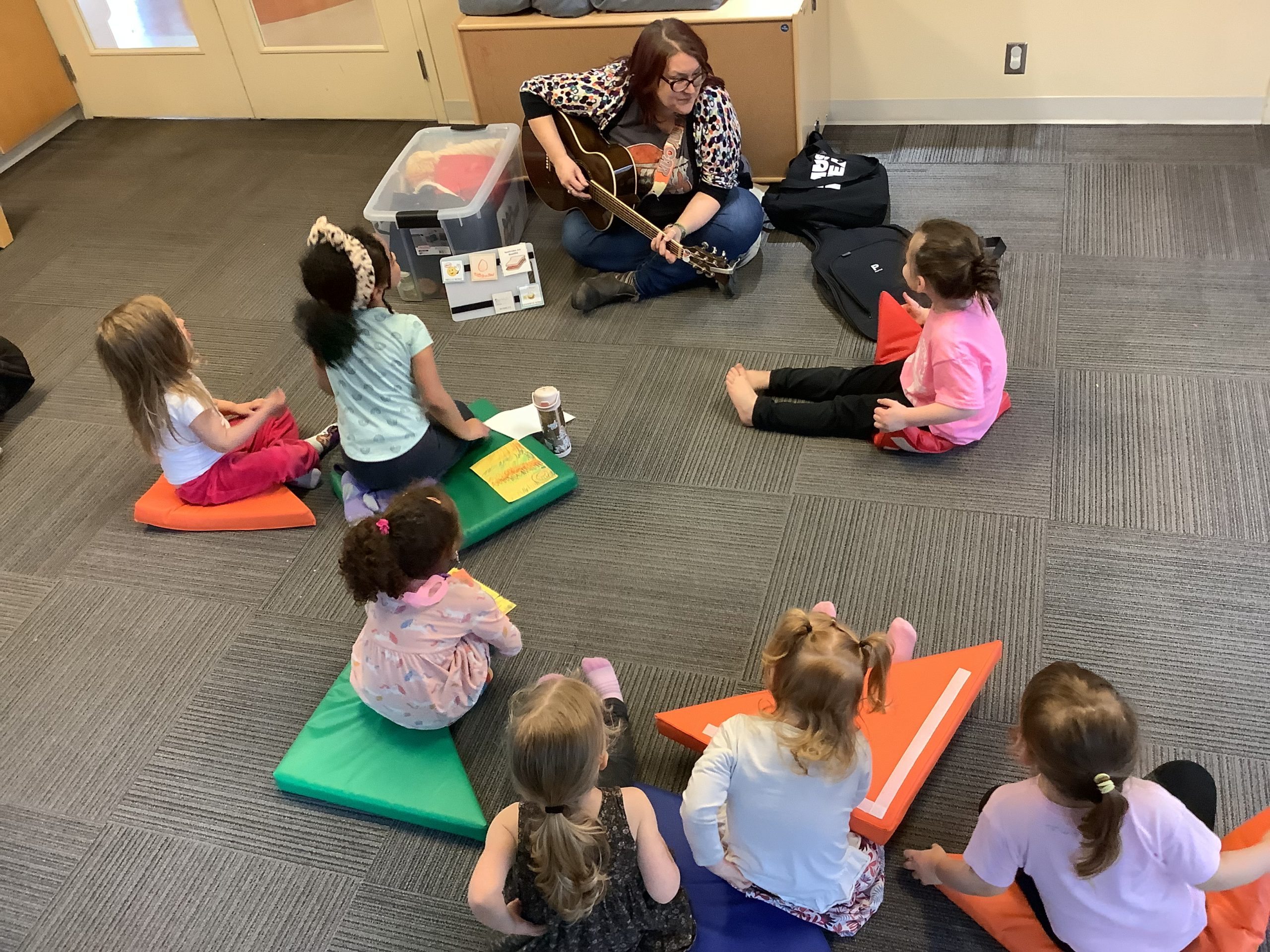
Children’s Music Therapy Group & Alexina Davis, Music Therapist, YMCA BC
Each session follows a predictable arc. “We always start with a hello song to help them transition into music time and know what to expect. And we end with a goodbye song for that same reason – it creates safety in the routine.”
As she leads the song, Alexina is already assessing the group – noting energy levels, engagement, and individual needs to gauge how the session may go.
“I’m very mindful of trying to follow an energy path,” she explains. “We start with the hello song, then we have this peak, and then we’re slowly moving down toward our goodbye song.”
After the introduction comes movement. “They’re jumping, stomping, spinning – a lot of gross motor work through music.” The goal is to release as much excess energy as possible so the children can transition into more focused tasks.
- Gross motor skills: the coordination, strength, and movement of large muscles in the arms, legs, and torso. Development begins at birth and progresses into infancy and childhood.
Once settled, the session shifts into smaller, more intentional movements.
“We’ll do something with our hands, like singing a cinnamon bun song and pretending to make a cinnamon bun,” she says. “We’re still moving, but I’m keeping their bodies and minds engaged with small movements.”
And as the energy tapers, calming songs follow – preparing the kids for the end of the session.
“The penultimate song is usually about breaths, whether it’s pretending to blow bubbles or blowing out a candle,” says Alexina. “But they also love doing scarfwork, where we’re playing with scarves to a quiet song.”
Finally, they end with a goodbye song, as Alexina guides the children to clean up their supplies and instruments before lining up at the door.
Music Therapy for Neurodegenerative Diseases
At the Strive Centre in Vancouver, music therapist Edwina Lin approaches each session through the lens of neurologic music therapy. Rather than focusing on musical performance, her work targets rehabilitation goals: movement, speech, cognition, and emotional well-being.
- Neurologic music therapy (NMT): an evidence-based program that uses music to support rehabilitation and enhance quality of life.
Edwina works with patients with developmental disabilities or brain injuries, and crafts her sessions accordingly. In a time where patients may have little control over their lives, she says choice is an essential part of her sessions.
“After a big injury, being able to choose what you want to do and with what songs is such a big thing,” says Edwina. “It really enables a client to feel empowered, like, ‘hey, I may not be able to move my body’ or ‘I may not be able to think as fast as before but I get to choose what I want to do.’”
Sessions often begin with music attention control exercises. Using drums, bells, or other instruments, her patients practice sustaining focus by following a steady beat.
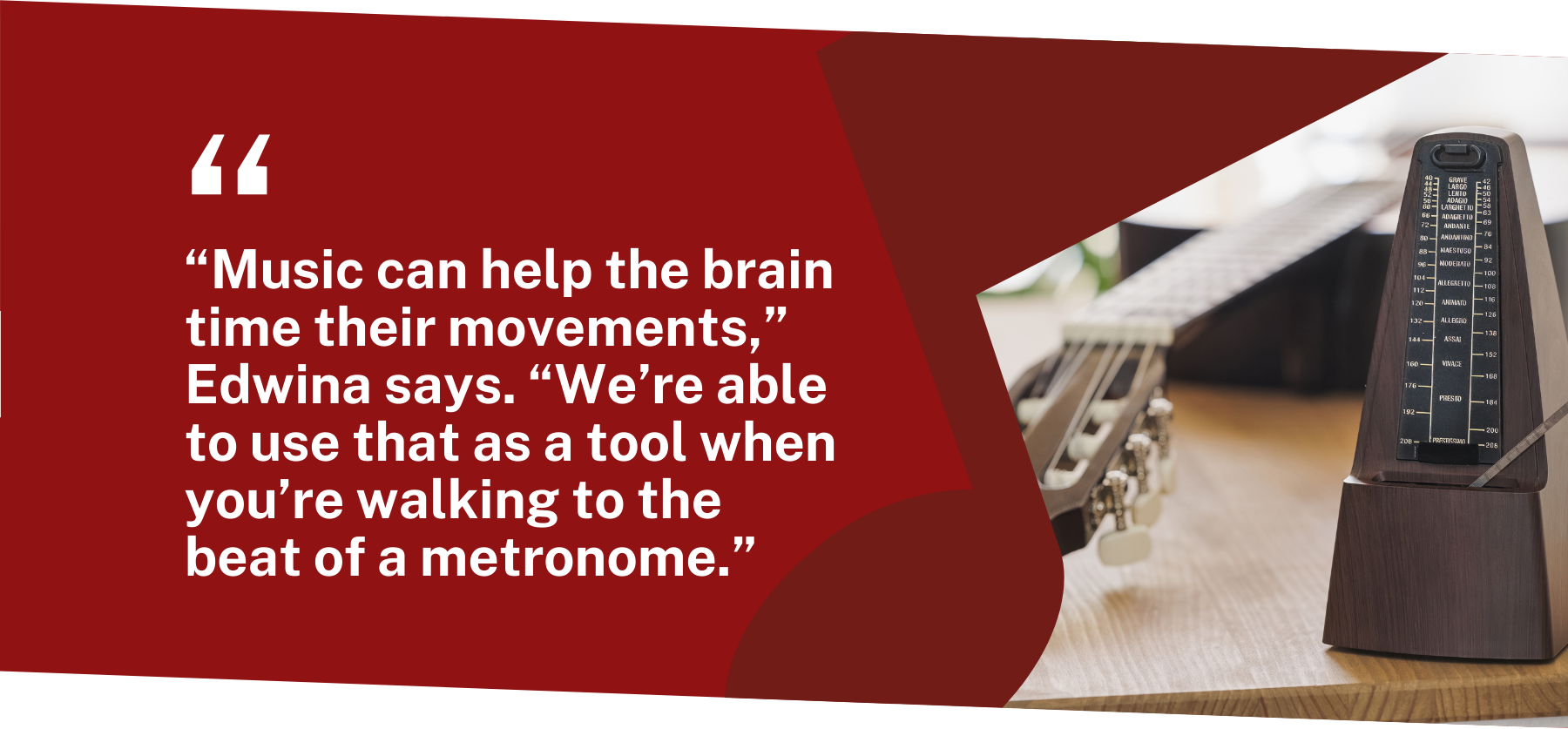
“We first started with just following the beat with a metronome, and that in itself was very hard for some of our clients,” she says. “It’s been a year, and now that’s our warm-up.”
Over time, the exercises progress. “Now I’m putting up different rhythms – like quarter notes, whole notes, half notes – and having them follow the rhythm. Then we’re adding a song, and the next step is writing our own rhythms and melodies.”
The gradual layering of complexity strengthens cognitive processing, coordination, and memory, Edwina saying that you can really see – and hear – the progress.
For individuals working on motor rehabilitation, rhythm becomes a physical cue. Steady, rhythmic sound can help regulate unstable walking or shuffling, common in those suffering from Parkinson’s disease.
Speech and language goals are also woven into sessions. For clients with aphasia, familiar melodies can stimulate language centres.
- Aphasia: a brain-based disorder that makes it difficult to speak, understand, read, or write words, often caused by a stroke or head injury.
Through therapeutic instrumental playing and structured melody exercises, Edwina says the music drives the change and facilitates movement, becoming a pathway back to communication.
“Music can be used to work on and target non-musical goals that affect your daily life, like cognition, being able to attend to a task, speech and language, motor skills, walking, moving your arms, psychosocial mood, expressing emotions – music can be so much more.” – Edwina Lin, Music Therapist
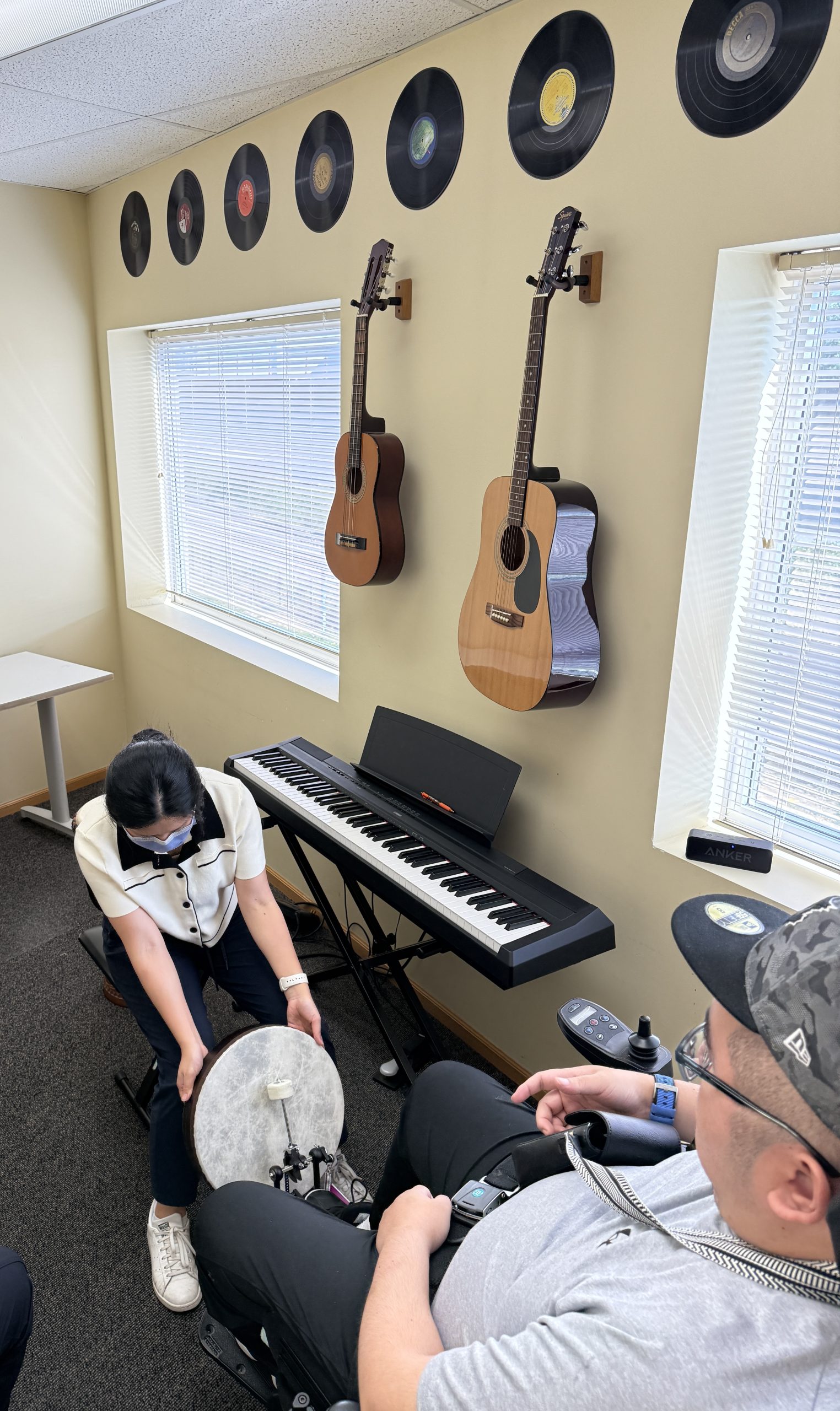
Music Therapy Participant & Edwina Lin, Music Therapist, Strive Centre, Vancouver
Music Therapy for Seniors in Long-term Care
In long-term care homes across BC, many residents live with dementia, stroke or cognitive decline – conditions that can bring confusion, anxiety, agitation, and deep social isolation. Music therapy creates space for connection in moments where words may fall short.
Through rhythm, familiar songs, and guided discussion, music therapists help seniors access memories, regulate emotions, and reconnect with their sense of self.
For seniors, drums and simple percussion instruments are often used to encourage engagement and attention.
“Drumming is nice because we all have that inherent rhythm in us – we all have a heart.” – Kayla Turnbull, Music Therapist
Kayla Turnbull, a music therapist at the Kelowna General Hospital, leads a drum group as part of her sessions for the McNair Psychiatric unit. “Just being in rhythm together can be so soothing.”
Like any other music therapy session, they can be adapted to each resident’s abilities. For some, that may mean improvisation or complex rhythm. For others, especially those further along in dementia, it may involve gentle hand-over-hand support to initiate movement.
- Hand-over-hand (HOH): a prompting technique where a therapist or caregiver places their hands over their patient’s hands to guide movements and teach certain actions. In music therapy, this can help with activities such as tapping a drum, strumming a guitar, or playing piano keys.
“Improvising on a variety of different instruments or movements can sustain their attention, and they can successfully remain seated, actively engaged, and have changes in facial affect,” says Aisling Ryan-Aylward, music therapist at Dufferin Place and Kiwanis Lodge, long-term care facilities in Nanaimo.
Beyond rhythm, familiar songs often spark meaningful conversations. Lyric analysis and reminiscence can open discussions about family, identity, and life experiences – helping residents feel seen and heard in environments where independence may be limited.
By offering both structured engagement and emotional expression, music therapy supports not only cognitive and physical stimulation, but also dignity, identity, and human connection.
Discover more about how music therapy is transforming long-term care experiences for seniors and helping them reconnect with themselves here.
—
Music therapy is never one-size-fits-all. It adapts to the individual – whether that means supporting movement after injury, helping a child regulate emotions, strengthening parent-infant bonds, or reconnecting someone with memory.
Through donor support, Music Heals has been able to bring this adaptable, evidence-based care to more communities in Canada. In 2026 alone, we have provided $555,000 in funding to 52 music therapy programs across the province.
Donations bring the healing power of music to people from all walks of life, ensuring that, whether in a neonatal unit, rehabilitation centre, daycare, or long-term care home, music can continue to heal.
Blog Article Written by: Orchid Solang, BCIT Journalism Intern